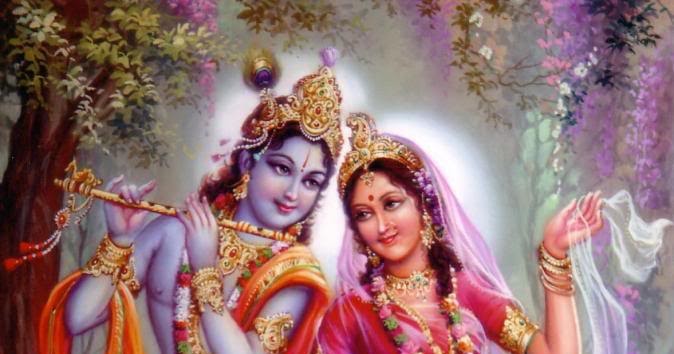
 Who is Sant or Sattvika Person -The Shrimad Bhagavad Gita
॥ श्रीमद्भगवद्गीता ॥ ॥ ॐ श्री परमात्मने नमः ॥ ॥ अथ श्रीमद्भगवद्गीता ॥ Shree Krishna has explained in chapters 14, 16 17 and 18 of Shrimad Bhagavad Gita about the different personalities of persons which are caused by the root material i.e. Prakriti (nature) having three attributes viz. Sattva, Rajas and Tamas in varying proportion. The different characteristics viz. state of mind, actions & doership, charity, spiritual duties, food habits, true knowledge, intellect, determination, joy and re-birth spell out about the Sattvika person. Sattvika persons are virtuous & kind and are having restraint of senses, regulation of the organs, freedom from enmity, correct judgement, the attainment of knowledge and supernatural powers. The Sattva being clean, is illuminating and flawless, it binds through attachment to happiness and knowledge (14.6). Sattva draws one to pleasure (14.9). Overpowering Rajas and Tamas, Sattva prevails (14.10). Wisdom and discernment in the body, mind and senses, Sattva element predominates. (14.11). Whatever is done without vanity (self-importance), but is motivated by the good of others and has the grace of God in mind, is sattvika. Those who are sattvika desire salvation and cultivate renunciation, divine love without motive, actions dedicated to God etc. and they will be drawn to Divine manifestations that bestow these excellences. Sattvika has effects like luminosity, peace, knowledge and pleasure and objects with such properties. Knowledge dominated by Sattva leads to understanding of unity in diversity; actions dominated by it tend to detachment and freedom from passionate affiliations; a doer dominated by it is comparatively free from ego-sense and attachment but yet does not lack enthusiasm and interest in the work; the intelligence dominate it is always accompanied by moral sensibility and eye on spiritual side of things; strength of mind is dominated by it expressed as control of senses & the mind and strict adherence to principles; and experience dominated by it is painful in the beginning due to difficulties in discipline, but ends in great bliss. The main attributes of Sattvika Person (Saint) are listed as under (in bracket, chapter.verse) (the relevant Sanskrit verses of Bhagavad Gita are mentioned at the bottom):
0 Comments
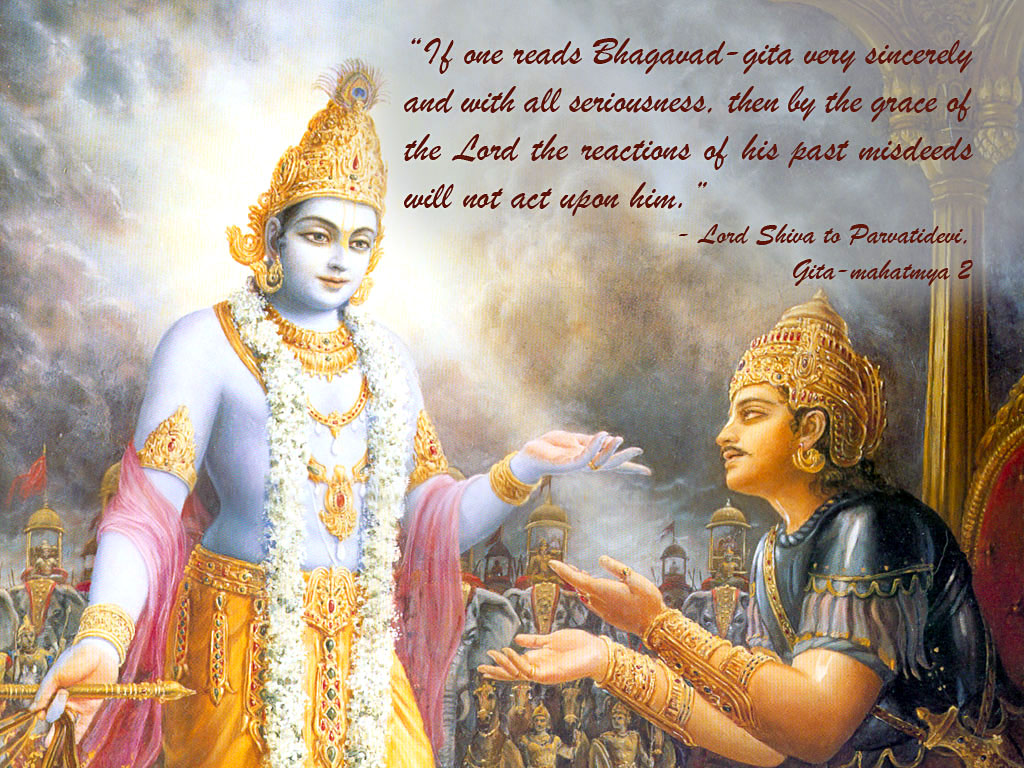 Who is Almighty - The Bhagavad Gita
॥ श्रीमद्भगवद्गीता ॥ ॥ ॐ श्री परमात्मने नमः ॥ ॥ अथ श्रीमद्भगवद्गीता ॥ Shree Krishna has explained about the almighty or Brahman (in Sanskrit, root bṛh means "to swell, expand, grow, enlarge") in chapters 7, 11, 13, 15 and 17 of Shrimad Bhagavad Gita. Brahman Supreme Brahman has two concepts viz. Nirguna and Saguna. Nirguna Brahman is formless, without attributes or quality. Saguna Brahman, in contrast, was envisioned and developed as with form, attributes and quality. Brahman is distinct from Brahma (one of the deities & mortal), Brahmin (one of the Verna) and Brahmama (one of the four ancient layers of texts within the Vedas). Supreme Brahman, the truth (Being)-consciousness-Bliss, is eternal, the ultimate reality and pervading all in the universe. Brahman is omnipresent, transcendent (supreme, divine), beyond time and space, but yet immanent in nature and in all beings – as light in the sun and other luminaries, as gravitation that keeps the galaxies in position, as fertility in soil, as digestive powers in all living beings and above all in the hearts of all as the living spirit from whom life, memory, intelligence, knowledge and everything else proceed. Supreme Brahman is the lord of the two beginning less entities Prakriti and Jiva is said to be neither Sat (being) nor Asat (non-being). Brahman is the the sustainer of beings (as Vishnu), the destroyer (as Rudra) and the creator of all (as Brahma). Brahman is knowledge itself, worth knowing, and worth attaining through real wisdom. The eternal Jivatma (soul) the fragment of the Supreme Being is the controller of the body etc. Around Jivatma is the mind, ego, Buddhi, senses etc. which are arisen from Prakriti. That is infinite, this is infinite. From the infinite, the Infinite has come forth. When the Infinite is subtracted from the Infinite, the Infinite remain. Om tat sat are the holy syllables & represent Brahman, and indicate the sacrificial mentality. Om is sound Brahman (शब्द) and the seed of all mantras, Tat means that indicating Brahman. Sat means truth or reality, is equally representing Brahman. Utterance of these syllables, promotes his spiritual evolution. Brahman is the goal and devotion, real wisdom, selfless karma & dhayan yoga are the paths. Shree Krishna has explained the attributes of Brahman & Jivatma as under (in bracket, chapter. verse) (the relevant Sanskrit verses of Bhagavad Gita are mentioned at the bottom): Chapter: 7 - Attributes of Almighty - I
Chapter: 11 - Almighty
Chapter: 13 - Attributes of Almighty - II
Chapter: 15 - Attributes of Almighty - III
Chapter: 17 - Om Tat Sat
Chapter: 15 - Jivatma
 The Bhagavad Gita – the Karma Yogi
॥ श्रीमद्भगवद्गीता ॥ ॥ ॐ श्री परमात्मने नमः ॥ ॥ अथ श्रीमद्भगवद्गीता ॥ The enlightened Karma yogi has no sense of agency, evenness of mind in favourable or unfavourable conditions and offer fruits of actions to almighty. Such yogi is free from bondages. Initially, he shall have the feeling of agency, so he should offer all the fruits of action to the Brahman. Later, the sense of agency is destroyed. Dedicated and detached actions are brought by Bhakti element. Real sanyasi and real karma yogi are not so different. Both should abandon all passions and attachments, hope and expectations. The only difference is that one who is early stages of the discipline, struggling to gain the non-attached conditions. The detailed explanations, chapter wise and verse-wise are as under (the relevant Sanskrit verses of Bhagavad Gita are mentioned at the bottom): Evenness of mind:
Absence of sense of agency:
Karma as duty:
Self-Surrender:
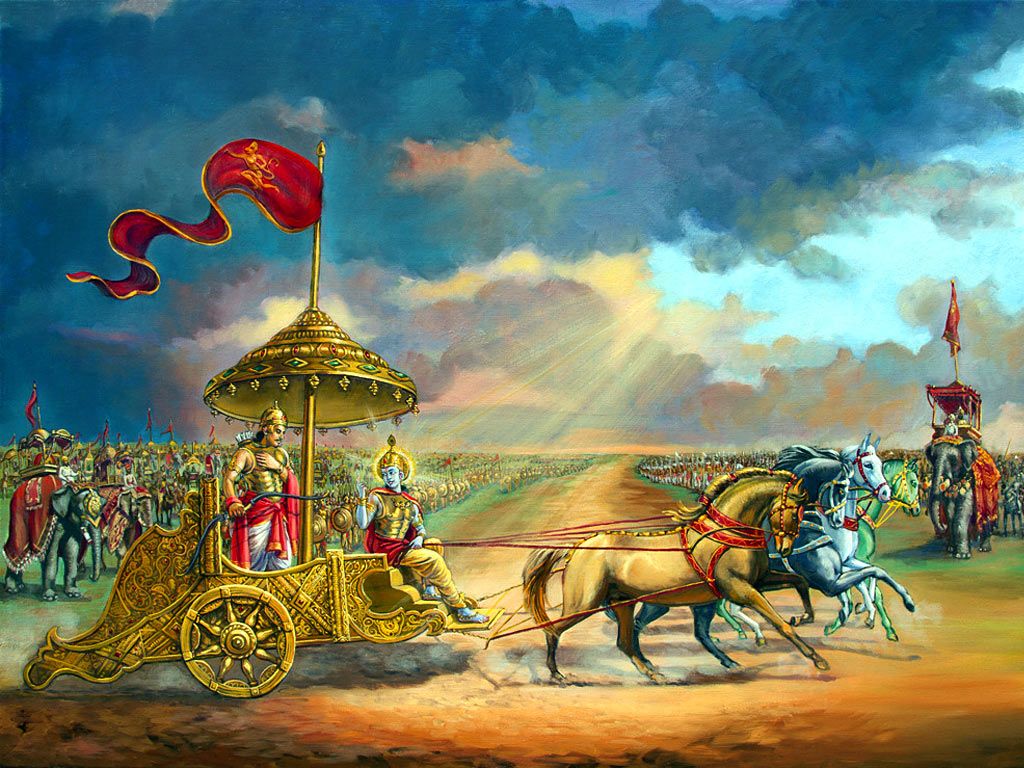 The Shrimad Bhagavad Gita – Varnas or Caste-System
॥ श्रीमद्भगवद्गीता ॥ ॥ ॐ श्री परमात्मने नमः ॥ ॥ अथ श्रीमद्भगवद्गीता ॥ There is great deal of misconception about the varna-system (caste system) in Hinduism. It is important to recognize, Varna is not genealogical or by birth or hereditary but by profession. The four Varnas are not lineages, but categories. The Shrimad Bhagavad Gita describes the professions, duties and qualities of members of different varnas. Shree Krishna has clearly explained in chapters 14 and 18 of Shrimad Bhagavad Gita about distribution of duties and Varna-system (caste system). In Shrimad Bhagavad Gita (chapter 15, verse 1 & 2 of Purushottam Yoga), Shree Krishna advised that the Supreme Being, indestructible, permanent and eternal is root and main trunk is Brahma and universe is its branches. All human beings are created formerly by Brahma. Hence, there is no distinction of Varnas. This whole universe is Brahman. The Shrimad Bhagavad Gita thereafter recites a behavioural model for Varna based on attributes (gunas) of the persons. These attributes arise from Prakriti (Nature). Prakriti is the conceiving Mother, of which, three gunas viz. Sattva, Rajas and Tamas are arise and tie down the imperishable soul to the body (chapter 14, verse 5). There is no entity on earth, or again in heaven among the Devas, that is devoid of these three Gunas, born of Prakriti. The pre-dominance of the particular gunas say sattvika are to be of category Brahmanas irrespective of birth. The work or duties should be adopted according to in-born Gunas of the persons and the categories of work are described as Brahmanas, Kshatriyas, Vaishyas and Sudras. With the evolution of societies in human beings, the work distribution also developed for the better synergy and ease of life. All societies, organisations and countries are marked by work distribution based on the capabilities and aptitudes. The duties of the Person according to the nature are defined (chapter wise and verse-wise of Shrimad Bhagavad Gita) as under (the relevant Sanskrit verses of Bhagavad Gita are mentioned at the bottom):
 The Bhagavad Gita – the Sanyasa Yoga (सन्यास योग)
श्रीमद्भगवद्गीता ॥ ॥ ॐ श्री परमात्मने नमः ॥ ॥ अथ श्रीमद्भगवद्गीता ॥ Shree Krishna has explained about the Sanyasa Yoga in chapter 18 of Shrimad Bhagavad Gita. Sanyasa (renunciation) is wholly renouncing the desire for all kinds of enjoyment of this world and the next. God may be realized through seven types of renunciation. Among them, it has been stated that, the first five types of renunciation indicate the first stage of Wisdom, renunciations upto the sixth type indicate the marks of the second stage of Wisdom, and renunciations upto the seventh type indicate the marks of the third stage of Wisdom. He, who attains ripeness in the third stage of Wisdom above, at once realizes God, the embodiment of Existence, Knowledge and Bliss. He loses all connection with this transient, destructible, impermanent world. Seven classes, the marks of renunciation are mentioned below:
In the person, who has reached the sixth stage of renunciation stated above, there may be, now and then, some slight manifestation of attachment, when there is any special contact with objects of enjoyment; but in the person, who has reached the seventh stage of renunciation, there can be no attachment, even when there is contact with objects of enjoyment for in his conception, except God, no other object remains. That is why this renunciation has been described as Supreme Dispassion. Following attributes make their appearance: Truthfulness (Statement of facts in sweet words, representing exactly what is realized by the mind and the senses),
The Sannyasa yoga is discussed by Shree Krishna as under (in bracket, chapter. verse) (the relevant Sanskrit verses of Bhagavad Gita are mentioned at the bottom): Sanyasa (renunciation) is giving up (wife, children, wealth, other goods and Yajna, charity, penance & puja etc.) of all actions motivated by desire and the wise declare that Tyaga consists in relinquishing the fruit of all actions (18.2). Sanyasi (man of renunciation):
 The Bhagavad Gita – the Dhyan or Raja or Kriya Yoga (राज योग / ध्यान योग)
॥ श्रीमद्भगवद्गीता ॥ ॥ ॐ श्री परमात्मने नमः ॥ ॥ अथ श्रीमद्भगवद्गीता ॥ Shree Krishna in Shrimad Bhagavad Gita has showed four paths of liberation viz. the karma yoga, the jnana yoga, the bhakti yoga and the dhayan or raja yoga. Path of Raja yoga is explained in chapters 6 and 8. The Raja Yoga is the conquering of the internal organs (mind, intellect and ego) by psychic control. Shree Krishna says, the Raja Yogi is superior to the ascetic (तपस्वी); he is regarded superior even to the persons who have knowledge of scriptures. The Yogi is also superior to those who perform action with some interested motive (6.45). Shree Krishna has explained that the Raja yogi should practise moderation in his daily habits—in eating; sleeping, recreation, etc.; practise meditation by sitting in a comfortable posture, with the head; neck and spine erect (not tensed) and fix his purified & unwavering mind on the Atman by concentrating between the eyebrows or on the tip of the nose. By regular meditation upon the Atman, Raja yogi gradually transcends the senses and intellect and merges himself in the blissful Atman. He finds that the bliss of the Atman is incomparable, that there is no gain greater than the Self. Having thus attained perfect union with the Self, the Yogi no more descends into ignorance or delusion. He does not relish any more the pleasures of the senses and once the yogi is well established in the Brahman i.e. state of bliss from which, even the greatest sorrow cannot shake him. Self-centredness goes away. This ultimately leads to the vision of the Lord in all beings and creatures. Shree Krishna assures that the practice can succeed through Vairagya (dispassion), regular practice, intense faith & devotion and strong aspiration for ascending in spiritual life. He assures Arjuna that the accumulated power of his Yogic practices will assure him a better birth in the future, with more favourable conditions for Sadhana. The detailed explanations, chapter wise and verse-wise are as under (the relevant Sanskrit verses of Bhagavad Gita are mentioned at the bottom): Who can do Meditation: The person, who has controlled his mind and body, is free from desires and void of possessions, live in seclusion and constantly engage his mind in meditation (6.10). How to do Meditation:
Precautions to do Meditation:
State of Mind of accomplished Raja Yogi:
Goal attained by Raja Yogi:
Re-birth of Raja Yogi:
 The Bhagavad Gita – Path of Devotion & Bhakti Yoga (भक्ति योग)
॥ श्रीमद्भगवद्गीता ॥ ॥ ॐ श्री परमात्मने नमः ॥ ॥ अथ श्रीमद्भगवद्गीता ॥ Shree Krishna in Shrimad Bhagavad Gita has brought out the nectar of Upanishads and outlined four paths of liberation from re-birth & to achieve highest spiritual goal. The paths are the karma yoga, the jnana yoga, the bhakti yoga and the dhayan or raja yoga. Path of bhakti yoga is explained in chapters 4, 7, 9, 10, 12 and 18. Bhakta is one who fix his mind daily, continuously & unmoved on the almighty; worship by listening, chanting, meditating & studying about almighty without motives; surrender everything to Him with great devotion & love; make obeisance to Him and entirely depending on Him. Four types of persons become devoted viz. sufferer, the enquirer, the boon-seeker and the knowing one. The knowing ones love the Brahman from their sense of innate unity with that. To them, nothing is dearer than Brahman. It is only after many births of spiritual striving that person is established in this form of love based on knowledge that it is Brahman alone who is seen as this world of multiplicity. Vedic system maintains that the Almighty/Brahman has manifested himself as several deities, who represent particular powers. The devotion to deities of most persons is mainly motivated by worldly needs like cure of diseases, success, wealth etc. A divine incarnation is the expression of divinity through humanity. Worship of incarnations is worship of Brahman himself. Wise persons know that the powers of the deities are derived from Brahman who fulfils the desires. Purpose of Worship (Devotion):
Forms of Devotion (Bhakti): The forms of Bhakti are three – Ekatva (based on unity, soul’s oneness with Brahman), Prthaktva (separateness, Brahman is master of all, adoring him as father or husband) and Bahudha (multiplicity, immanent of all being, and service to all beings). Worship of shiva, Vishnu, Devi, incarnations etc. is done with understanding that it the one supreme being who has manifested as all these deities that it is He who is worshipped through them all. Types of Worship:
Attributes of devotion: The three qualities viz. Shraddha, ardent practice and control of senses, are absolutely necessary for spiritual progress.
Types of devotees:
Progress of Devotion:
The detailed explanations, chapter wise and verse-wise of Shrimad Bhagavad Gita (the relevant Sanskrit verses of Bhagavad Gita are mentioned at the bottom) are as under: 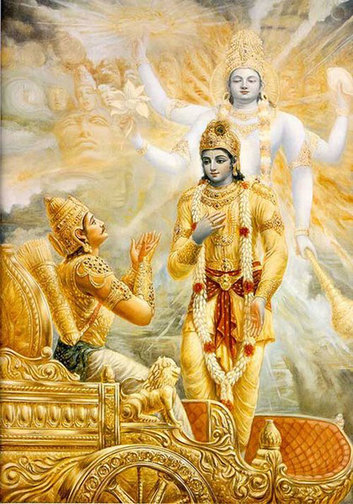 The Bhagavad Gita – Path of Jnana Yoga (ज्ञान योग)
॥ श्रीमद्भगवद्गीता ॥ ॥ ॐ श्री परमात्मने नमः ॥ ॥ अथ श्रीमद्भगवद्गीता ॥ Shree Krishna in Shrimad Bhagavad Gita has explained the four paths of liberation from re-birth. While seen dejected Arjuna, Shree Krishna first threw light of true knowledge (Samkhya Yoga in Chapter 2). He explains, Soul is eternal, hence dejection is not appropriate. He made discourses on Jnana Yoga (Samkhya Yoga or Yoga of Knowledge) in several chapters of Bhagavad Gita. Jnana yoga or Samkhya Yoga is the path of wisdom, knowledge, and direct experience of Brahman as the ultimate reality. Knowledge is recognition of the truth that soul is only uninvolved witness in whose presence prakriti functions and fading of ignorance. Engaging one in action with mind steadfast in Yoga, abandoning attachments and even mindedness in pleasure & pain, success & failure, is called Yoga. By overcoming delusions, one develops a state of indifference towards the past experiences & experiences yet to come. Impulses are generated constantly in mind which may be negative or positive. Yoga brings serenity of mind and thus helps in correct decision making. Intellect has power to choose or reject the impulse. But people react habitually before the intervention of conscious & intellect. With calmness brought by yoga and meditation, intellect express the decision to get assent of consciousness before organ of actions react. According to Samkhya philosophy,
Jnana Yoga of the Bhagavad Gita has many parallels with the original Samkhya philosophy of Kapila (already an article is published under category of Philosophy of this website). The main tenets of path of Jnana Yoga are as under (in bracket, chapter. verse) (the relevant Sanskrit verses of Bhagavad Gita are mentioned at the bottom): Introduction of Jnana Yoga:
Steady (stable, evenness) State of Mind:
Attributes of Intellect:
Ture Knowledge (wisdom):
Attributes of Soul:
Brahman (almighty, Purusha, Shree Krishna)
Liberation:
Hence, Jnana Yoga is the attainment of true knowledge about the Prakriti, soul and Brahman.  The Bhagavad Gita – Creation & Dissolution of Universe
॥ श्रीमद्भगवद्गीता ॥ ॥ ॐ श्री परमात्मने नमः ॥ ॥ अथ श्रीमद्भगवद्गीता ॥ Shree Krishna has explained about the creation and dissolution of universe, birth, death, re-birth and salvation in chapters 7, 8, 9, 10, 13 and 15 of Shrimad Bhagavad Gita. Shree Krishna informs Arjuna as under: Creation and Dissolution of Universe:
 The Bhagavad Gita – the Karma Yoga
॥ श्रीमद्भगवद्गीता ॥ ॥ ॐ श्री परमात्मने नमः ॥ ॥ अथ श्रीमद्भगवद्गीता ॥ Shree Krishna in Shrimad Bhagavad Gita has brought out the nectar of Upanishads and outlined four paths of liberation from re-birth & to achieve highest spiritual goal. The paths are the karma yoga, the jnana yoga, the bhakti yoga and the dhayan or raja yoga. Path of karma yoga is explained in chapters 2, 3, 4 and 18. Karma Yoga means action, devotion and contemplation; all combined, this attains spiritual perfection. Welfare of the world and not the selfish objectives becomes the purpose of actions such as rising of sun. Spiritual evolution has stages of discipline of karma combined with contemplation and karma without attachment. The persons do karmas (work, actions, and activities) based on motives and motivations which may be due to selfish interest or as duty or due to community, country or humanity. Karmas or actions may be classified in three categories viz. interested actions with motives, disinterested actions with full of energy without personal motive and uninterested actions without full inclination. Karmas are virtuous, vicious or detached and are accounted for and ongoing account is maintained. All karmas are a mixture of beneficence and destructiveness as far as their effects are concerned. They are like the brilliance of fire, always accompanied by the obscuring cloudiness of smoke. Natural tendencies and Karma:
Stages of Karmas: Karmas have three stages viz. Idleness or passivity, karma desiring fruits i.e profit motive (Kamya-karma) and Naiskarma (wilful worklessness or actionlessness).
|
 RSS Feed